Over the past two decades, women have been moving up in manufacturing often in corporate functions. Between 2004 and 2024 they added 420,000 jobs in the sector's high-wage professional and management occupations, rising from 1.22 million to 1.64 million. Manufacturers Alliance reported that shift in Women Are Growing Industry's High-Skills Future, along with the finding that women have been moving out of administrative roles and into professional ones.
Overall, women represent 29.1% of manufacturing's workforce, which is 4.4 million women working in manufacturing. Within the overall number, women hold a somewhat higher share of its management, business, and financial roles, at 33.2%.
While this growth in professional roles is a positive for women, the overall growth has not maintained pace. The Current Population Survey counted 5.0 million women in manufacturing in 2004 and 4.4 million in 2025, a fall of about 595,000 women in a sector that shed a total of 1.35 million jobs.
What changed was the mix of roles. Women in management, business, and financial roles rose 36% over those two decades, from 748,000 to just over a million, while women in office and administrative support fell 40%, from 1.08 million to 643,000. The advance into higher-wage work was steady, and it happened while the layer beneath it was contracting.
The Exposure Underneath
The gain is concentrated in professional and corporate functions. Beneath those functions sits the office and administrative layer, where women still make up the majority of the workforce, and that layer is now the most exposed part of the sector.
Bureau of Labor Statistics (BLS) projects office and administrative support employment inside manufacturing to fall from 941,100 to 859,900 between 2025 and 2035, a loss of 81,200 jobs or 8.6%. That is the steepest decline of any occupational layer in manufacturing, and nearly twice the national rate for the same work. BLS attributes the national decline to AI-powered automation of routine workflows.
Women hold a disproportionate share of those jobs. Office and administrative support is the most female-dominated layer in manufacturing at 60.7% women, against 29.1% across the sector as a whole. A UK study published in October 2026 by Noetic AI for Beko found the same concentration there, estimating that 41.1% of women's manufacturing employment sits in occupations exposed to generative AI against 23.6% of men's. In the U.S., the divergence is already in the data rather than in a projection: Pew found that across occupations scored for AI exposure, men's employment grew 6.3% per point of exposure between 2017–19 and 2023–26, while women's barely moved, at 0.2%.
If you look at the numbers by careers, office and administrative work accounts for 14.6% of women's employment in manufacturing and 3.9% of men's. Apply each layer's projected change to where each sex actually works, and women's manufacturing employment carries a ten-year outlook of +0.3% against +1.7% for men. Both are positive, but almost all of the growth runs to jobs that men already have.
Over two decades, women in manufacturing's management roles rose 36% and men 14%. In office and administrative roles, women fell 40% and men 20%.
The pressure reaches above the clerical line. BCG expects many organizations to see functional headcount fall 25% to 40% over time, particularly in middle layers, which is the director tier sitting directly on top of those functions.
Women Are More at Risk
What consolidation removes is routine work: transaction processing, data entry, reconciliation, first-line service. What stays is judgment. Finance and human resources do not disappear. They get smaller and more senior.
Manufacturing is hiring, and hiring widely. Of the 22 occupational groups BLS tracks inside the sector, 15 are projected to add jobs through 2035 and only five to lose them, with management and business functions both in the growing column. But the growth is lopsided. The ten occupations adding the most jobs account for close to 160,000 between them, led by industrial machinery mechanics, industrial engineers, and mechanical engineers.
Set those two movements beside each other, and something new appears.
Manufacturing's Fastest Growth Is in the Layers Where Women Are the Scarcest
Each occupational layer inside manufacturing: women's share in 2025, against projected employment change in that layer, 2025-35.
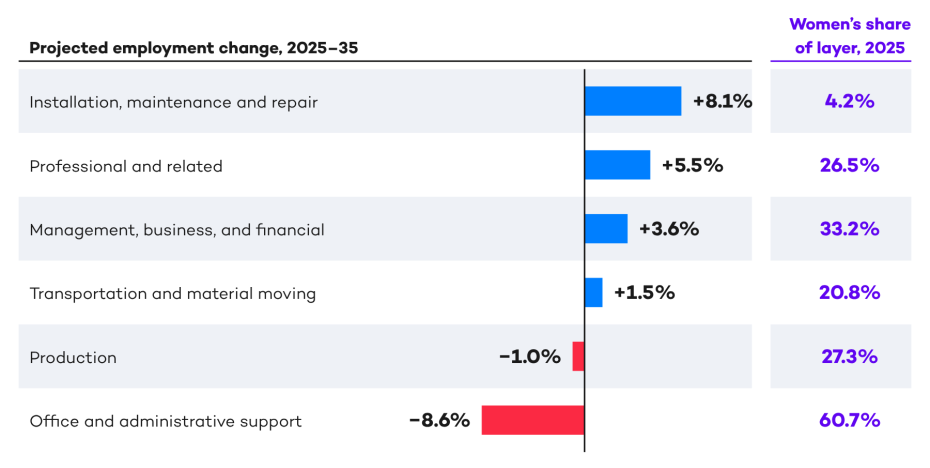
Blue marks layers gaining jobs. The most female layer has the steepest decline; the least female, the strongest the growth.
Source: BLS Current Population Survey, Table 17, 2025 annual averages, and the BLS National Employment Matrix, manufacturing (31-330), 2025–35.
For the first time, the corporate ladder is losing rungs in the same decade that the operations track is hiring. Women have always held operating roles in manufacturing, in smaller proportion than men but never absent from them. However, for the past twenty years, women’s job growth has been concentrated in professional and corporate functions rather than in plants and business units. As the layer beneath those functions thins, manufacturers have an opportunity to shift seasoned career women into new roles.
There are 1.7 million women in manufacturing's management, business, financial, and professional occupations. The bench already exists. The question is no longer how to bring women into the industry; it is where the women already inside it go next.
On a Path to Leadership
We evaluated the chief executive and named executive team of 32 large manufacturers operating in the U.S., drawn evenly from aerospace and industrials, autos and machinery, food and consumer products, and chemicals, pharmaceuticals, and medical devices, using company leadership pages and Securities and Exchange Commission (SEC) filings retrieved on November 2, 2026.
Of the 32 sitting chief executives, 31 held operations or profit-and-loss responsibility before the top job. They came up through plants, segments, and business units. A few were finance or engineering executives who ran a business before moving up.
Six of the 32 are women. Four reached the top on an unbroken operating ladder. The other two came up through engineering or finance and ran a business before the final step. This path is documented and proven as a successful route for many women.
The question is how many women are currently on this path. Across those teams we counted 370 named executives, 97 of them women. Thirty-one of those women hold an operations or profit-and-loss (P&L) seat, and just over half of the thirty-one sit in only four of the thirty-two companies. The evidence shows that routing women to leadership roles happens deliberately.
The pattern is not unique to manufacturing, and it is not new. The Women's Power Gap Initiative found women hold 24% of the launch positions on S&P 100 executive teams — the roles carrying real P&L and operational responsibility — and calls that experience a prerequisite for the top job. Spencer Stuart's April 2025 study of 2,300 senior women worldwide found 70% are in or have been in a role with P&L responsibility, and nearly 60% had their first P&L role in the first ten years of their career. The differentiator is early P&L responsibility, which companies assign rather than individuals acquire.
Tough Decisions Ahead
Manufacturing is making unusually hard decisions right now. Companies are looking at where to place capacity under tariffs and which parts of the network to rebuild and which to let go. They are simultaneously deciding how far to push AI into operations. None of these come with a playbook.
Unfamiliar decisions reward varied experience, and the people who make these particular calls are the ones holding operating authority. That is the practical case for routing women into leadership roles in operations. A wider range of expertise in the seats where the sector's hardest questions get settled gives companies broader insights and varied experience.
A retention argument runs alongside it. Manufacturers Alliance survey data shows 32% of large enterprise manufacturers naming a lack of advancement opportunity as a primary root cause of voluntary attrition among salaried staff. If the corporate ladder loses rungs and nothing is offered in its place, manufacturers will lose senior-level women they spent twenty years developing. The rungs are not disappearing by choice: BLS attributes the national decline in office and administrative work to AI absorbing routine workflows, so the pressure arrives on its own schedule whether or not a company has a plan for it.
Keeping those women at the company is an important goal. That cumulative presence took two decades to assemble. A recruitment problem is solved by changing who applies, which means reaching back into schools and trade programs and waiting a decade to learn whether it worked. A routing problem is solved by changing who gets moved, and that is a succession decision available this quarter, with people already on the payroll.
How to Take Action
The first move costs nothing but attention: count how many women at director level and above have ever carried a P&L. Some companies track this privately, while others have never had reason to ask. Either way the number is where to start, and it is worth having before the next succession cycle rather than after it. The second is to look at the operating roles filled over the past two years, in the plant, segment, division, and region jobs, and work out what share went to women. This measures routing rather than intention, and it belongs in front of the executive team with a name attached to it.
The harder question is which corporate functions are scheduled for consolidation over the next three years, and who inside them sits on a succession slate for an operating role. When those two lists are held by different people, a company can run a careful workforce plan and a careful succession plan and still lose the same women.
Manufacturing spent twenty years moving women into its professional ranks, and they are there now, experienced and senior, in functions about to be reshaped. Companies can route that talent toward the work it is adding, or it can let those highly qualified women disappear.
AI Transparency: Content for this article was analyzed and written with assistance from an AI tool and reviewed by the Manufacturers Alliance research team.

