Where the Risk Is Concentrated
Not every imported mineral carries the same risk. Potash is 92% imported, mostly from Canada. Gallium is 100% imported, and China produces about 99% of the world's primary supply.
Our analysis of U.S. Geological Survey (USGS) data puts 13 minerals in the high-risk zone, where the United States imports at least half of what it uses and one country controls at least 60% of world output. The minerals include: bismuth, cobalt, fluorspar, gallium, graphite, indium, magnesium, niobium, platinum, rare earths, silicon, titanium metal, and tungsten. China is the leading producer of 10 of them.
Thirteen Critical Minerals Combine Heavy Import Reliance with Concentrated Supply
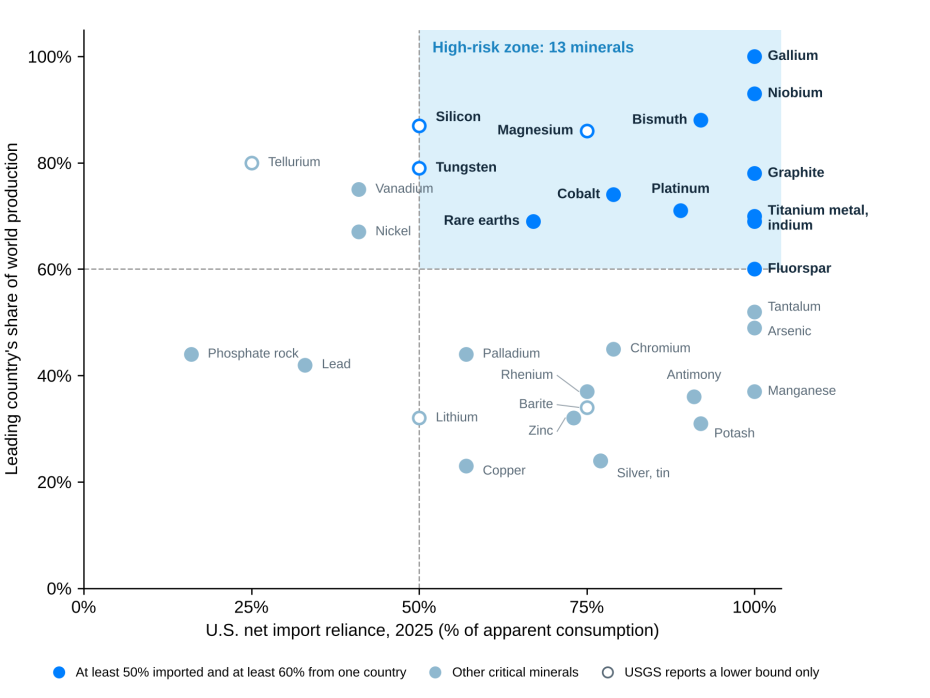
Minerals without published reliance or production shares (e.g., germanium, scandium, yttrium) are omitted; net exporters (beryllium, boron) excluded. Hollow points: USGS reports a lower bound only.
Source: Manufacturers Alliance analysis of USGS Mineral Commodity Summaries 2026, Table 7.
These are small markets with large manufacturing footprints. Gallium sits inside power semiconductors, radar, and LEDs. Bismuth and indium go into lead-free solders, tungsten into cutting tools, and dysprosium and terbium into high-temperature magnets. A small disruption in tonnage can idle a large production line.
Supply Chain Watchlist
The table combines the 13 high-risk minerals with those under Chinese export licensing in 2025. It is a starting point for bill-of-materials reviews, not a complete list.
Source: Manufacturers Alliance analysis of USGS Mineral Commodity Summaries 2026, Table 4 and Table 7. Uses are typical applications, not a complete list.
A new country of supply does not always mean a new source. China is the leading refiner for 19 of 20 strategic minerals, with an average share of about 70%. The U.S. mined 51,000 tons of rare earths in 2025 yet relied on imports for 67% of the processed compounds and metals factories buy. A processor outside China may still refine Chinese feedstock. When qualifying alternatives, ask where the material was mined and refined, not only where the part ships from.
Export Controls Are Showing Up in Prices
Our analysis of USGS price data shows what export controls cost. Critical minerals under Chinese export licensing rose a median 23% in price in 2025. All others rose 3%. USGS attributes all three spikes to export restrictions.
Every mineral that more than doubled in price was on China's control list: bismuth (+270%), antimony (+144%) and germanium (+106%). Over five years, licensed minerals compounded at a median 5.5% a year, versus 1% for the rest.
Minerals Under Chinese Export Licensing Rose 23% in Price in 2025; Others Rose 3%
One-year price change, 2024 to 2025, for each U.S. critical mineral USGS tracks.
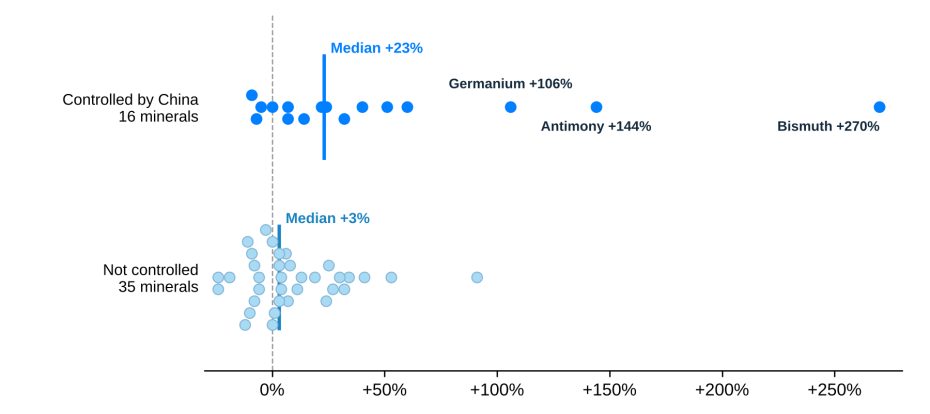
Controlled = Chinese export licensing in force during 2025. Four rare earths with suspended October 2025 controls excluded.
Source: Manufacturers Alliance analysis of USGS Mineral Commodity Summaries 2026, Figure 10A and Table 4.
Who absorbs that premium depends on where a company sits in the chain. Direct buyers, such as magnet, semiconductor, and specialty alloy producers, pay it in full. For most original equipment manufacturers, the larger exposure is availability.
Manufacturers Are Acting and Keeping Options Open
Manufacturers Alliance data tells us manufacturers have moved from watching to acting. In our January 2026 tariff update, 77% had changed their physical supply chains, up from 56% in April 2025. Only 27% describe those changes as permanent.
Costs are reaching the income statement too. In a Manufacturers Alliance CFO survey, the share reporting higher cost of goods sold rose from 65% in February 2026 to 82% in May 2026.
Real changes that stay reversible fit this risk. Requalifying a supplier is slow and expensive, and price shocks arrive immediately.
Policy Is Buying Time, Not Supply
Public money is flowing into the gap. Washington has approved up to $10 billion in EXIM financing for Project Vault, a $12 billion civilian minerals reserve, and more than $2.5 billion in federal loans and awards for processing, magnets and recycling. The reserve is now preparing up to $1 billion in loans to manufacturers to buy and store the minerals, magnets and alloys they request.
Funding does not shorten mine timelines. Only three new U.S. mines reached production between 2002 and 2024, and in October 2026, a copper mine opened in Arizona, the first opened in the U.S. in 18 years. Beijing's trade arrangements with the United States now run to Jan. 10, 2027, and its licensing regime on seven heavy rare earths remains in force.
Dates to watch:
- Nov. 27: China's suspension of its gallium, germanium and antimony ban expires.
- November and December: Trump and Xi are scheduled to meet at APEC and the G20.
- Jan. 1, 2027: DFARS rules extend the ban on Chinese-origin magnets, tantalum and tungsten in defense deliveries back to mining, refining and separation.
- Jan. 10, 2027: China's broader U.S. trade arrangements expire.
Your Company’s To-Do List
The minerals are small. The exposure is not.
AI Transparency: Data for this article was analyzed with assistance from an AI tool and reviewed by the Manufacturers Alliance research team.

